Showing posts with label Israel. Show all posts

Friday, January 20, 2012

Israel (Jordan technically), Day 13: Petra

Today we made our way to the Hashemite Kingdom of Jordan. Currently under governance by King Abdullah II , Jordan is now on it's third king. King Abdullah's predecessors: his father King Hussein reigned from 1951-1999, and his grandfather King Abdullah reigned from 1921-1951.

The border entry gate between Israel and Jordan. This took us an hour, but it was worth it. I'd definitely go back to Jordan any day.
The King is held in extremely high regards in Jordan, his picture--along with the pictures of his father and grandfather are displayed prominently across Jordan. We saw at least 5 different displays of King Abdullah II on our way between the Israeli border patrol office and the entrance to Jordan. He was appointed the Crown Prince of Jordan only weeks before his father passed away from leukemia--at Mayo Clinic in fact.

The country of Jordan is a monarchic country, the monarchic family is the Abdullah family, descendants of the Hashemite family who ruled the Hashemite kingdom before and during the time of Mohammed. They family does have a direct connection to Mohammed, by blood and therefore have declared Jordan to be a Hashemite kingdom.

The sign welcoming us all to the Hashemite Kingdom of Jordan. We had to present our passports a total of 5 times to enter the country, and 4 times to return to Israel. It was surprising, but understandable.
We went through border security, it took about an hour for us all to get through. The main chunk of time (about 45 minutes) is when we had to give up our passports for them to be inspected, stamped, and checked by the Royal Jordanian Military. We were then given the all clear to enter the country and make our way to Petra. As we started to head up the mountains it got incredibly foggy. After about half an hour of driving, we noticed this little sight:

Look very carefully at the sand on the other side of the road......
Yup. That's snow. It snowed in the desert... That says something about winter in Minnesota this year. They got about 4 inches of snow here in Jordan (it clearly didn't stay, but 4 inches of snow fell overnight and this morning), pretty sad considering Minnesota can barely keep any snow on the ground at all this winter.

After a 2 hour drive through the pea soup fog in the Jordanian mountains, we reached the city of Wadi Moussa--the city that surrounds the ancient city of Petra. Petra was discovered in 1831 by Francis Burkhart of Switzerland. During an exploratory mission through the Jordanian desert, Burkhart noticed there was a facade that was sticking out of the ground. He sent word back to Switzerland, where a crew was sent to start excavations around the facade. That's when they discovered this: a large temple/monument carved into the sandstone. After heavy research, the building was dated at over 1850 years old (now over 2000 years old).

The original discovery made by Francis Burkhart. He only found the top 5 feet or so, but  this is what was uncovered during excavation.
The ancient city of Petra stretches for miles and miles through the canyons and crevasses in the sandy desert in the center of Jordan. We were able to climb up some of the old steps of the city and get a panoramic view of the old city, which you can see stretches for miles in the distance.

After we were all exhausted from hiking down the canyon, to see one of the new 7 wonders of the world, we boarded the bus and headed up the hill in Wadi Moussa. We stopped at the Amra Palace Hotel--a 5 star hotel that over looks the city and the Petra entrance facilities--and had a wonderful buffet lunch. I had THE BEST dessert I have ever had in my entire life. It's called Om Ali. It's an Egyptian dessert--literally translated it means mother of Ali. It's similar to bread pudding. It usually includes phyllo dough, dried fruit--strawberries of cranberries, any kind of nuts, heavy whipping cream, and cinnamon. It's baked and served warm, and is absolutely amazing.

Om Ali, the best dessert I have ever had... ever!
After our wonderful dessert, we boarded the bus and all lapsed into a coma until we reached the border with Israel again.

Tomorrow we're headed to Beersheba, 'the capital of the Negev (desert)'. It's home to Beersheba University one of the largest universities in Israel, and is also located near the grave of Ben Gurion, considered the George Washington of Israel.

I'll have an updated on our excursion in Beersheba later tomorrow night, unless we don't have internet access.

Thanks again for reading everyone!

Wednesday, January 18, 2012

Israel, Days 8-9: Kibbutz Gonen, the Sea of Galilee, and Kibbutz Ashdot Ya'akov

We began day 8, Sunday, with a trip from our stay at Kibbutz Gonen, located at the foot of the mountains in the Golan Heights, to the Golan Heights region.

These flowers are all over every kibbutz or moshav we visit. They're beautiful year around, which seems marvelously outrageous because we'd never have anything that could live outside all the time during the month of January.
We spent our day winding our way up the mountains to get a glimpse into Syria from the top of some high ridges. We heard briefly about the fear of the Israeli government that when the Syrian dictator, Assad, falls there will be a flood of Syrian refugees who leave the country for Israel. They're working furiously to protect the border so when/if it does happen, there will be no problems with illegal crossings.

We then stopped at a coffee shop at the peak of the mountains in the Golan Heights to talk about the war of 1967 and the continued mortar attacks against the kibbutzes along the border with Syria. The Syrians used to sit on the top of the mountains and fire rockets and mortars down the hill and they tried to blow up as many houses and civilians as they could, so the Israeli army, in 1967, decided to invade Syria (along with the West Bank, and the Sinai peninsula. They whole point of the invasions was to conquer land with which to trade back in exchange for peace and recognition of Israel as a state.

The sun cuts through the clouds making for a spectacular scene. It almost didn't look real to me!
After some time spent in the Golan Heights, we worked our way down to the southern tip of the Golan Heights, to the upper Galilee region. There we stopped at the small town (now a tourist site and excavation area) of Capernaum. The city's name interestingly means nothing, there is no work for it in any language. It was an attempt by the Romans to name the city based off of its Hebrew name, they just added letters and switched the meaning of the word so that it now means nothing.

Capernaum, or known to many orthodox/eastern Christians as the Capharnaum. The place where Jesus centered his teachings.


This is the city where Jesus met Simon (Peter). Jesus' main center for teaching the bible was here and he first met Simon here. The city sits right next to the Sea of Galilee (which is really just a lake--smaller than many lakes in Minnesota). The Sea is the only fresh body of water in Israel. It provides fresh water to all of Israel, the West Bank, Gaza, and parts of western Jordan. The legend is that Jesus walked on water here, when really, the lake is so shallow when it first starts out that one could walk the length of a football field and it would only be up to your knees.

We didn't spend too much time at Capernaum, so when we started going again, we stopped at the part of the Jordan river that is south of the Sea of Galilee, it looks much more healthy than the northern part of the stream. The lake acts like a natural barrier to much of the muck the river picks up on it's way down stream.

Another radiant beam of sunshine. When you don't see the sun for 4 days of vacation, when you do see sun it's amazing! :)


After seeing some live Jordan River baptisms, we decided to head to our hotel for the night which was Kibbutz Ashdot Ya'akov.

Saturday, January 14, 2012

Israel, Day 5: Tel Aviv-Jaffa

This has been a great a great day so far. We were allowed to sleep in until 10am today. It was glorious. I feel so rested that after I post this I think I'm going to go out on an adventure in Tel Aviv! :D

The highlight of the day was our discussion at the group meeting this evening. We were talking about the things that we've noticed and have been thinking about since our last group discussion (three days ago) and we got onto the topic of the Palestinian perspective and how we all agree that it has been lost on our trip. We have a WONDERFUL tour guide named Amir. He's an Israeli native who grew up in Jerusalem on a kibbutz. His family helped fight in the war of independence in 1948 and he has been a part of the Labor party ever since he could vote. Although we all love Amir, his perspective is blatantly biased towards the Israeli side of every issue. Although it's great to hear the Israeli's side to every event, we would rather have that side also told with the opposing (or not so opposing) view point from the Palestinians.

There is a nice quality to learning about a topic and you hear about it from more than one (or even two) sides. I feel like we're incredibly heavy on the Israeli side and it makes it extremely difficult to sift through all the information without opposing view points. The other day, we talked with a Palestinian Christian named Ibrihim. He explained to us that many Palestinians don't believe what most of the Arab countries believe, he thinks that there should be a peaceful end to the conflict, and he believes that Israel should be the one and only state that exists on the land.

To many of you, this may seem shocking, "How could a Palestinian want Israel to be the only state that prevails out of the two state conflict that exists today?!" Well it's actually a relatively easy but unrealized answer. Ibrihim is Christian, a very small minority in the Israel and the rest of the Middle East these days. The Christians are all pushing for either an Arab nationalist state or the State of Israel to prevail out of the conflict. Christians know they will be heavily persecuted if Palestine prevails and an Islamic republic is installed, because under an Islamic republic, Islam is the one and only allowable religion. Therefore, if a secular Arab state or a Jewish state is created or kept in power, the Christians will be left largely alone and they will most likely not be affected.

Beautiful view of a mosque which sits roughly 20 feet from the Mediterranean Sea.
The rest of the day today besides discussing the Palestinian side of the conflict was spent touring Tel Aviv and the old city of Jaffa (they are now considered to be the same city). The first site (and only) site we stopped at in Tel Aviv was the site where Yitzhak Rabin was assassinated by a religious Jewish zealot. Rabin was the first Prime Minister of Israel to open talks directly with Yasser Arafat. He was willing to make concessions and deal directly with Arafat to create a solid and lasting peace with the Palestinian people. Shortly after his announcement of planned peace talks at the Tel Aviv government square, Rabin was shot in the back three times by a radical religious Jew who was mad at Rabin for even suggesting negotiating territory away with the Palestinians.

Memorial for Yitzhak Rabin.
After we left the site of Rabin's assassination, we headed to the old city of Jaffa, and toured the currently-being-revitalized port and old city district in Jaffa. There is a beautiful contrast of old and new in Jaffa. Many old buildings that have fallen deep into disrepair are brought back from the brink of devastation and given new life by wealthy real estate moguls who want to revitalize the 'tired city of Jaffa'. We stopped at two places in the old city that really stood out for me. We stopped at the shop of a Yemenite Jew who immigrated from Yemen right before WWII. This man, Ben Zion David makes Yemeni jewelry, mainly out of silver, using generations old tools and techniques that have been handed down through his family since the 1700s. After observing some silversmith-ing at work, we moved on to a very special theater. Its name is Please Touch, its a theater company in which all the actors are blind, deaf, or both. This theater was one of the first things in the dilapidated old port district of Jaffa that is now being beautifully renovated. This theater company has captured region wide appraisal for it's incredible contribution to the community, and the world of artwork--where no disabilities can prevent you from creating your own kind of are.

David Ben Zion, the Yemenite silversmith who showed us his craft by creating a piece of jewelry in 10 minutes. It was incredible!


The theater company's review by the Guardian: "It's a test of theater itself, the way good work can communicate across the boundaries of darkness and silence."

That's all I have for this day. Tomorrow we'll be heading to Haifa, the 'working city' in Israel! Stay tuned!

Monday, January 9, 2012

Israel, Day 1: Jerusalem

My blog will mainly consist of my link to my facebook photo album from my first day in Jerusalem.

We mainly followed the Christian story in Jerusalem today. We followed the Via Dolorosa (the way of agony), the Holy Week for Christians. We saw the Temple Mount former religious center for the Jews and Christians; now ruled by Muslims. We went to some historically significant sites like the Roman excavations and ancient walls which protected the ancient city.

We learned how Jerusalem even became the epicenter of three major monotheistic religions. We were 'reminded' that the Jews were not the ones responsible for the death of Jesus, the Romans were.

I'll have more posts with more information on Jerusalem in the next few days, but as I said, an enormous amount of information can be found on my new Facebook album; located here: http://www.facebook.com/media/set/?set=a.10150478640878170.362559.576288169&type=1

Airports... Airplanes... and Israeli Security

I started my journey to the Israel on Saturday, January 7th, 2012. We took off from Minneapolis Saint Paul International at 3:50 pm, and flew to New York City. The flight from MSP to NYC was very nice, and quiet. We even landed about ½ an hour early!

We landed in NYC at 7:00 on Saturday night. We all spread out throughout the airport to look for dinner and a little time to relax. At 8:30, were to meet back up near the ticket gate so that we could start preparing for security and ticketing.

You might think that security for a flight headed to Israel is the same as if you were traveling to any other place abroad, but it’s not. El Al (Israeli Airlines) provides its own security screening for all flights in and out of Israel. So about 8:45, we all got in line to start the security process. To set the scene: the front of the airport at the ticket counters in the airport is nearly empty at this time, except for the area around the El Al ticket counter, where there are roughly 500 people who must go through Israeli security before they get on the plane.

If you have an Israeli passport, you need only go through ‘basic security’. If you have a foreign passport, you are required to go through the ‘foreign security’ line. In the ticket counter area, there were extremely long lines that started at the security check point, which was located about 100 feet from the ticket counter that went far down the ticket counter area. At the security checkpoint there stands 8 Israeli security agents with black music stands, long lists of expected passengers, and handheld scanners for passports.

When it was my turn to go through security, I walked up to one of the agents and handed her my passport. She began by asking questions like: what is your name, where did you come from today, where are you going in Israel, how long are you staying, etc. Then she asked some more obscure questions such as: do you know anyone in Israel? … I paused for a slight moment… I said yes (mistakenly saying I knew someone from Israel, when in fact I know someone from Occupied Palestine). She then asked for the name of the person (Martha Younan). This immediately aroused suspicions. She left me standing at the music stand and walked over to a very large man in all black with sun glasses on (I started to get nervous as this started happening).

She came back and immediately started with more questions. How did you meet her (the National Lutheran Youth Gathering in 2009), how long have you known her (2.5 years), did she know you were coming to Israel or did you tell her (I told her), have we kept in touch since we first met (yes I have, over Facebook), do you know where she lives (Jerusalem). She left abruptly, returning to the large man in all black. She then returned with a barrage of questions. Did you contact her about your visit or did she ask if you were coming to Israel (I contacted her), where did you pack your bags (home), who packed them (me), was anyone with you (no), are you carrying anything from someone else (no), did someone else put anything in your bags (no), are you carrying any weapons, sharp objects, or anything that can be used as a weapon or tool to bring down the aircraft (no), do you know where she lives in Jerusalem (no), do you know her family or friends (no), do you know her address or phone number (no), did you make any plans to meet (no), are you going to be in contact with her while in Israel (I’m not sure)? By this time, I was getting very concerned because the rest of my group had been long gone through security and were waiting past the ticket counter.

The security woman left the stand again, this time I couldn’t see where she went and she was gone for about 10 minutes. Finally, she returned with my passport and said have a nice flight to Israel, sir.

Finally, I caught up with my group and we got through the rest of security to our gate. I thought that security and everything was over when one of the men I had seen behind the 8 security agents came running across the gate area and shouted that everyone needed to move out of the area… We all moved very quickly away from him, when we saw 2 men coming over with poles and ropes to cordon of the area around a backpack that had been left unattended in the gate area.

Just before we were supposed to board the airplane, a man appeared and claimed the bag as his own. Whew, we all thought, now we can finally get on the plane, but that’s when one of the security agents came up to a member of our group and told her that they needed to take her carry-on bags and search them. They said she could remover her passport, money and computer and that they would be taking the rest. The security agent disappeared until about 10 minutes before the plane was to take off. We later discovered that Sarah (the girl whose bags were taken) has family in Iran, so she too was grilled by the security agents and her bags were thoroughly searched.

Now we finally got on the plane and started the 11 hour flight to Tel Aviv. We left the gate at 11:50, and took off at exactly midnight on Sunday. The pilot told us that we flew up the eastern sea board to Newfoundland, east to Denmark, where we turned southeast towards Greece, turning south into the Mediterranean and east towards Israel. The route we took actually saved us time and we landed 40 minutes early at 5:05 pm Israeli time.
The Austrian Alps. Flying over at about 2:30 Israeli time... at least that's what I had marked down.  Who knows I was out of my mind tired! I didn't sleep much on the plane because they served meals at 4 hour intervals, and in between meals for  an hour and a half at a time, the religious Jews moved back and forth from the back of the plane to pray. 2ish hours of sleep, weeeeeeee!


Then it finally hit all of us… we were FINALLY IN ISRAEL! We made our way through customs and found our luggage. We met our tour guide for the trip, Amir, a good friend of my professor and her husband.

We are staying at the Yizhak Rabin Guest House and Youth Hostel in Jerusalem. We are within walking distance of the Israeli Knesset (House of Parliament), The Israeli Museum, The Israeli Supreme Court, several Ministries (Finance, Defense, Foreign Affairs, Immigration Absorption, just to name a few).

A night time view of the new city (Jerusalem) from the accidentally trespassed back courtyard of the Israeli Supreme Court building. :) We wanted to explore and the boundaries are not clearly marked like they are here... Well they are, except we can't read Hebrew (see next photo).
The sign telling Angela, Sarah, and me that the Supreme court is open from 8:30-1:30, and that we probably shouldn't be trespassing on Israeli Governmental property, especially the Supreme Court of Israel. Oopsies.
I’ll be writing a blog post after today’s tour, which will also count as my first blog post for our group’s blog: hamlinetohaifa.blogspot.com. The next post on my blog, and the first post on the group blog will be the same.
Picture of my room at the Yitzhak Rabin Guest House and Youth Hostel.  My bed is on the left, and my roommate Gavin's on the right. Out the window, though you cannot see it, there is a scene of the Israeli Museum on the top of the ridge across the street.
Thanks for reading this everyone, I hope you enjoy!

Wednesday, January 4, 2012

Getting Ready to Go

It's surprising how much work goes into traveling overseas! I've had to do so much work to prepare to go to Israel for just two and a half weeks. I decided to go on this study abroad trip the week before the deadline to sign up for it. It has been a whirlwind of preparation since that second week in October (yup, that's right, I signed up only 3 months before this trip was scheduled to happen). :)

I worked furiously to get all of my financial aid paperwork in, in time for the loan to be disbursed before the balance of the $5300 payment was due. I worked with the International Studies and Study Abroad office to obtain all the correct health and travel information (all was due the week I decided I wanted to go).

I had to go to a passport office to get my picture for my passport and apply for a passport. I didn't know it would be SO expensive to apply for a passport ($145 with a picture!!). Luckily I didn't need a visa because I STILL may not have gotten my passport back from the Israeli consulate in Washington. I'm incredibly excited to finally be within days of heading to Israel. The past three months have felt as if they passed at a snails pace.

We continue to study for four hours each morning. Today, we studied the foundations of Christianity, and the way it influenced the Israeli (technically Palestinian historically speaking) area. We're currently reading and discussing a book called Israel/Palestine by Alan Dowty. The book goes into great detail of the Israeli-Palestinian conflict, which is very helpful at this point. Although I did take the course my first semester here at Hamline, it's helpful for me as a refresher. When we get to Israel, we'll be listening to tour guides and guest speakers talk about historical parts of the conflict. Without having this historical context, it would be a great deal harder to understand the complexities of the conflict and the country it's centered around.

We had quite a lengthy discussion today about the incredibly complex makeup of the Israeli ethnic and religious landscape. There are literally hundreds of individual religious groups in Israel; the vast majority of which are sects of the 3 major religions in Israel: Islam, Judaism, and Christianity. One thing many people don't seem to understand about the conflict is that ALL of these groups have a stake in the division of the country; so it's not as easy as making an agreement that satisfies both the Jews and the Palestinians (although that goal is vastly helpful). The problem with only solving the problem for these groups is that decisions have to be made about where the other factions of these religious groups would reside after the country is divided.

The Christian population of Israel is very small compared to 20 years ago. The Christian population that used to comprise nearly 20% of the Israeli population in the late 1980's, has now withered to around 2%. Many of the Bedouin Muslim groups have driven them out of their villages because of conflicting religious views. The most persecuted religion in the Middle East is Christianity, namely because they are by far the smallest of the major monotheistic religions in Israel. The (moderate) Jews are known to be the most tolerant of the religious groups in Israel. Many 'Jews' in Israel, in fact, are not religious Jews at all--they are ethnic Jews. That is to say that they are non-practicing Jews, but are ethnic Judeans--from the ancient tribe of Judea (the only lasting tribe of the ten ancient Israelite tribes divided after the Davidic kingdom ended).

 Some unknown but sizable minorities in Israel are the Bedouin Muslims and the Druze. Bedouin Muslims are nomadic people who show no allegiance to the country in which they reside. They prefer to remain nomadic, often living in caves or make shift shelters, squatting and staying in different places. The Druze are a separate religion that combines Shi'a Islam and Greek philosophical beliefs. Nearly 95% of Druze followers live in the Middle East; mainly in Syria, Lebanon, and Israel.

I'm now almost ready to go to Israel. I just received my Israeli power adapters in the mail today, and I got my  bank card recognized for overseas use in Israel and Jordan. I called my cell phone provider, but unfortunately they do not offer overseas reception. So I will be using my blog, Facebook, e-mail, and Skype for communication while in Israel. Any and all of these sources are going to be checked everyday, so if you'd like to contact me, just send me a message through any of those sources and I will respond to them! If you wish to Skype with me, the time difference from Minnesota to Israel is +8 hours. I'll mainly be available from 10pm or later in Israel, so if you wish to contact me on Skype, your best chances of getting a hold of me on Skype would be between the hours of 2 and 6pm US central time.

That's all I've got for now. I'll update the blog either tomorrow or Friday. Then again on Saturday before I board the plane. Thanks everyone for following! I'm very excited to share my experiences with you while I'm in Israel! :)

Monday, January 2, 2012

First Class Period

I had my first class today. We started at 9 am this morning and went until 1:15 this afternoon. We introduced ourselves and learned more in depth about the historical background of Israel/Judaism/Islam/Christianity and the like. We're starting to delve into the whole security situation.

Because there is no active war going on, Israel/Palestine is a generally safe place to visit at this time. In 2009 (the last Hamline visit to Israel) there was a war and there was only one concern about violence. This year is expected to be very quiet. There is one town on the border of the Gaza Strip that we'll be visiting that could be of minor concern, but we can't be certain until shortly before our visit later this month.

Tomorrow we'll be discussing the foundation of the Israeli-Palestinian conflict and it's meaning in the context of the history of both sides (specifically with regards to each group's ties to the land).

We've already discussed Israel's claim to the land--the ancestral home of Israelites/Jews. Their story goes all the way back to biblical times, when Abraham settled in the mountains that are now located in western Israel and the West Bank. The Jewish/Israelite people were then conquered, subjugated, exiled, persecuted, and massacred as new empires rose and fell. After 578 BC, Jews were exiled permanently by the Romans (minus a few very small and isolated tribes throughout the area), many of them landing in central and eastern Europe.

After living there relatively peacefully for centuries, European nationalism began posing a threat to the Jewish people, and Jews were persecuted throughout Europe as well. Beginning in the 1880's, the idea of Jewish nationalism--also known as 'Zionism'--began to unite Jews across the world. Theodore Hertzl called for an international zionist congress in 1897, and declared that within 50 years the Jewish people would have a state.

Soon after, the first aliyah (migration) took place, were an initial 35,000 Jewish settlers landed in the Ottoman Empire client state of Palestina--a state created after the Jews were exiled by the Romans in 587 BC. A second and third aliyah took place afterwards until World War I. The third and fourth aliyah took place after World War I until the global economic crisis in 1929, few Jews migrated during this period. The fifth, largest, and final aliyah happened between the years of 1933 and 1939, the years between Hitler's election to office and the start of World War II. At this time, western countries had quotas and didn't allow any Jews from eastern and central Europe. There was also a large uprising starting on the part of Palestinians to stop Jewish immigration at this time. In fact, the only place other than Palestine that accepted Jewish immigrants was the Dominican Republic.

The only reason Palestine accepted Jewish immigrants is that the United Kingdom had control over the area because after the fall of the Ottoman Empire the League of Nations created 'mandates' that divided control of the dissolved Ottoman Empire among the allied powers--mainly France and the UK. So with British control, Palestine remained an open but limited place for Jews to immigrate. This forced exodus is what has caused much of the friction between both sides.
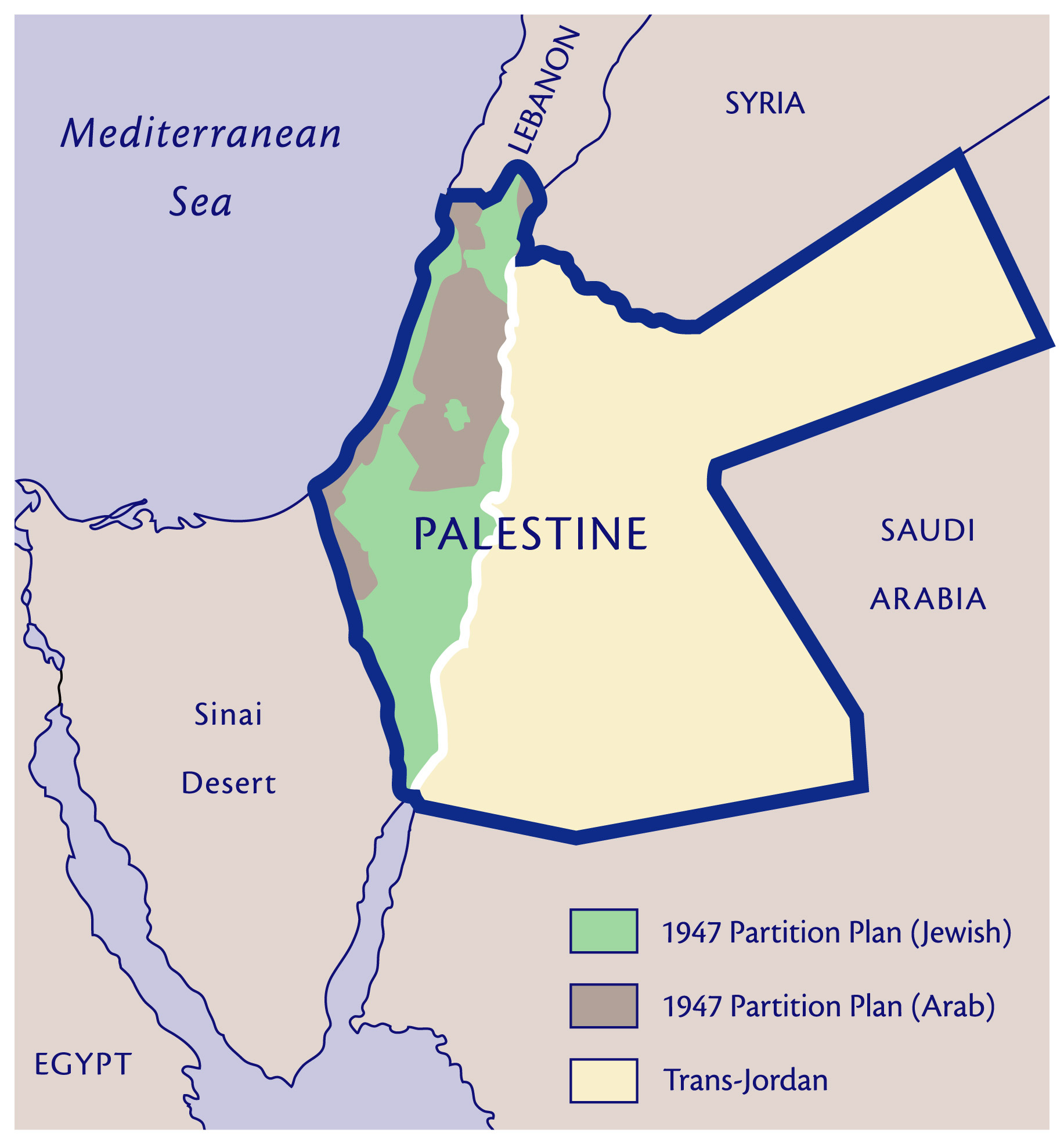
Above is a map of Palestine before the partition by the United Nations in 1947. The outline in blue is what was formerly known as Palestine. During the aliyahs, Jews only settled in isolated locations west of the Jordan river (the faint white line  running down the center of the outlined territory). After the Partition Plan was passed by the UN General Assembly, all area east of the Jordan river was declared to be the Kingdom of Transjordan (today known as Jordan, under the reign of the Abdullah family). The area west of the Jordan river was to be divided 55/45 between Israel and Palestine respectively. The green area represents Israel and the brown represents Palestine.

The heart of the issue between Israelis and Palestinians is that they're both vying for the same piece of land. Israelis claim rights to the land based on their ancestral homeland. Palestinians lay claim to the land because they occupied it for roughly 2000 years after the Jews were exiled. This tension was only exacerbated by the newly formed United Nations' decision to create a new Jewish homeland called Israel in the land known as Palestine (this was done in part due to the guilt felt by the west for 1) knowing what was happening to the Jews in central and eastern Europe and 2) not having acted quickly enough to stop the atrocities).

Although this barely skims the surface of the incredibly complex issue that is the Israeli-Palestinian conflict, this does give an idea of the greatest portion of the dispute between both sides, and it's foundations.

Friday, December 23, 2011

Itinerary and Flight Plan Received

I just received my itinerary and flight plan for Israel! We're spending time in: Jerusalem, Bethlehem, Ramallah, Tel Aviv, Haifa, Akko, Rosh Hanikra, Kiryat Shmona, Kibbutz Gonen, Golan Heights, Ashdot Yaakov, the Dead Sea, Masada, Eilat, Petra, Be'er Sheva, Rahat, and Shaar Hanegev.

FLIGHT DETAIL:
Flying out of MSP at 3pm on the 7th, and landing at 5:25pm on the 8th in Tel Aviv.
Leaving from Tel Aviv at 12:40am on the 25th, and landing in MSP at 3pm on the 25th.

I've added maps and destinations in the photos attached.

TRIP DESTINATIONS:

A-D Destinations

A&D are the same destination and are shown as 'D' on the map. These destinations are located in central Israel, Tel Aviv located in the upper left on the Mediterranean Sea, and Jerusalem in the lower right in central Israel.
E-K Destinations

Haifa (E) is located north of Tel Aviv on the Mediterranean Sea, very tropical, could be compared to New Orleans in the US. Destinations G, H, I, J, and K are all located on a border or in disputed territories. J is the Golan Heights--disputed territory between Syria and Israel. K is a kibbutz-a commune called Gonen, where although land is owned privately, profits and crops are all sold and shared collectively.
L-Q Destinations

Destinations M is a large port city located in the southern most part of Israel. It has been an area of dispute in the past, but with peace agreements between Israel and Egypt and Israel and Jordan, the area today is peaceful. Destination N is located in Jordan, it's an ancient city that was discovered in the sand dunes in Jordan. Excavation of the old city has been taking place steadily for many decades. Here is a link to pictures of Petra: https://www.google.com/search?q=Petra+Jordan&hl=en&prmd=imvnso&tbm=isch&tbo=u&source=univ&sa=X&ei=bdj0TvSrIMXAtgfwqOTqBg&ved=0CDcQsAQ&biw=1366&bih=677

Destination L, located on the far right, is the Dead Sea, the most saline isolated body of water on earth, it's also located below sea level. Destinations O, P, and Q are located on the edge of the desert in southern Israel. Destinations M and N are JUST outside the range of this map.

Some background on Israel:Israel was created in 1948 by UN charter. Although Israel is an area that has been plagued with violence since its creation, the past several years have been relatively peacful in nature. Currently, both sides of the Israeli-Palestinian conflict agree on nearly all issues and how they should be resolved, the obstacle at present is that conservative parties on both sides will not budge and agree to a compromised 2-state solution (which the vast majority of residents on both sides advocate).

My professor has said that although there has been violence in some parts of Israel lately, NONE of the destinations we will be visiting have seen violence in several years