So, since Thursday was my last blog, I need to put an update. Friday night we had a hotel with internet, but I didn't post a blog because by the time we were done with class, I literally couldn't keep my eyes open. Saturday and Sunday, we were at places that didn't have internet connections (wireless anyways), and today, I have to sit in the dining hall to find some free internet.
So I'll give an update on all the happenings as of late, and direct you to my Facebook page to look at the last three photo albums I've added (Day 6, Days 7&8, and Day 9).
On Saturday, we spent the day making our way from Tel Aviv to Haifa. Normally, the drive from Tel Aviv to Haifa would take about 45 minutes, but we took a detour to the east on our way there. First, we stopped in Nazareth (a surprisingly small and unimpressive village), where we talked to a man named Rassan, a Sufi sheikh who started a center for peace and coexistence in a town where hostilities, especially between Christians and Muslims have hit a peak.
Nazareth, a formerly entirely Christian town started slowly declining in its Christian population, has started to become more and more Muslim. As the Muslims move in, they begin to create hostilities with Christians; small acts of violence started in the mid-90's, but reached a peak during the second intifada in 2004. Rassan told us a story about his son. Shortly after he and his partner, a Christian minister from the Basilica of Annunciation, founded their peace center, Rassan's family began to experience attacks for being "traitors of the Palestinian cause" even though his family is Palestinian.
One day, during the height of the intifada, Rassan's son was brutally beaten until he went into a coma for two weeks. The incredible tension that has built up between the Christians and the Muslims has even created inter-Muslim fighting because they see people who work for peace as "collaborators" with the Israelis who want to squash the Palestinian cause... But the vast (and very silent) majority of Muslims do not agree that Muslims who want peace are traitors--because many of them are for peace.
In fact, many of them are interested in a solution as soon as possible. I was surprised to hear from both Palestinians that we've talked with, that they want to see a SINGLE state solution, preferably an ISRAELI state... I was blown away when I heard this from the mouths of Palestinians. Their explanation of this view is is that the interim government is too corrupt and they'd rather live under the Israeli government, then their own, corrupt government.
This sounds like a happy solution to the conflict, but not so. Israel wants nothing to do with the West Bank. Israel, founded as a Jewish state, does not want to annex the West Bank because there are enough Muslims living in the West Bank that the balance of Jewish to Muslim citizens inside the state of Israel would swing towards the Muslims, who would then constitute the majority in Israel. The Israeli's fear is that if this happens, the populous will vote more Muslims into parliament and the Israelis will go to being a suppressed minority in what was supposed to be their own country.
This is what makes this struggle so difficult. There are so many different eccentricities to every detail of society, that when people that don't live here try to help solve the conflict, there are aspects that get overlooked and there is an upheaval of discontent to each agreement that is made. Of course there is no perfect solution that will make everyone happy, but there is a solution that could make the most people happy, and it's just a matter of achieving that goal.
After Nazareth we headed to Moshav Nahalal (from here out Nahalal). A Moshav is much like a kibbutz, but less communal. At Nahalal, there are 75 families that live in the same area (that has now become a town called Nahalal). The organization of the city is in the shape of an oval, with a center plot of land that has an oval shaped road that goes around it, and each family with an equal plot of land that surrounds the oval. In the center there are all the essential services for the Moshav: post office, supermarket, schools, the dairy, small shops, and the town hall.
Around the outside of the road, every family has their home built next to the road, with their 12.5 acre plot of land extending out behind their homes in a wedge shape; this makes for an incredible overhead view. :)
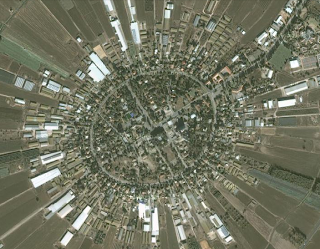 |
| Moshav Nahalal as seen from the air. |
We had the best lunch I have EVER had in my entire life, and it was vegetarian surprisingly. It was a 3 course meal that was served at Nahalal by a man who was generous enough to share his home with us. His wife cooked for us and he told us his story. In short, he's the fifth generation of his family to live in Nahalal (he's in his 60's) and the sixth and seventh generations now live there as well.
Nahalal has a wide variety of different flowers, fruit trees, and wonderful other products of all different varieties. They sell their produce collectively outside of Nahalal all across Israel, whatever one contributes to be sold, they will receive in return after the produce has been sold. It's essentially a capitalist kibbutz.
While in Haifa, we spent most of our time visiting the Baha'i center for the Baha'i religion. A religion that I've found fits all my beliefs, almost exactly. It's a religion that follows the teachings of all the major religions throughout the world. It recognizes all the prophets from Moses to Mohammed, and also recognizes it's own prophets: the Bab, and Baha'u'llah, prophets who heard messages from God saying that humans should recognize the oneness of humanity, the equality of everyone, men, women, all races etc., it recognizes Baha'u'llah's teachings about humanity, and the idea of service to mankind as a central part of religion.
The Baha'is have a SPECTACULAR garden located on Mount Carmel in Haifa, the gardens descend down from the top of the mountain to the Mediterranean Sea. Filled with different varieties of flower, trees, and shrubs, the gardens are a place of peace and reflection for people of all faiths, especially the Baha'is. The Baha'is are a religion of peace and promote the equality of all. There are roughly 6 million Baha'i people world wide. The Baha'i religion started in Iran, but the Baha'is were badly persecuted during the Iranian revolution in 1979 and have since left in great numbers for Africa and South America. Although the gardens were closed due to the rain making the limestone paths incredibly slippery, we were able to get some great pictures of the gardens.
The next day, we spent the day driving up the coast to Rosh HaNikra, the part of the border between Lebanon and Israel that touches the Mediterranean. At this point, there are giant cliffs of chalk that touch the ocean, and for thousands of years, the sea has slowly been eroding the chalk away from the cliffs and has opened large grottoes, or caves, in the side of the mountain. Today the grottoes are a big tourist attraction, that we visited.
After Rosh HaNikra, we drove along the Lebanese border to Kibbutz Gonen, a small kibbutz on the border with Syria... it's located in the 'finger' of Israel, the farthest norther tip of Israel that extends partly into Lebanon and partly into Syria. We spent our night there and awoke the next day to learn more about kibbutz living and troubles on the border with Syria.
Sorry I didn't get a post up sooner, and I'm missing pictures, but the internet access is very spotty to non existence in the kibbutzes. If you would like to see some of the 300 pictures I took in the past 4 days, you can go to my Facebook page to see them:
http://www.facebook.com/danielgerdes2011/photos


