It's surprising how much work goes into traveling overseas! I've had to do so much work to prepare to go to Israel for just two and a half weeks. I decided to go on this study abroad trip the week before the deadline to sign up for it. It has been a whirlwind of preparation since that second week in October (yup, that's right, I signed up only 3 months before this trip was scheduled to happen). :)
I worked furiously to get all of my financial aid paperwork in, in time for the loan to be disbursed before the balance of the $5300 payment was due. I worked with the International Studies and Study Abroad office to obtain all the correct health and travel information (all was due the week I decided I wanted to go).
I had to go to a passport office to get my picture for my passport and apply for a passport. I didn't know it would be SO expensive to apply for a passport ($145 with a picture!!). Luckily I didn't need a visa because I STILL may not have gotten my passport back from the Israeli consulate in Washington. I'm incredibly excited to finally be within days of heading to Israel. The past three months have felt as if they passed at a snails pace.
We continue to study for four hours each morning. Today, we studied the foundations of Christianity, and the way it influenced the Israeli (technically Palestinian historically speaking) area. We're currently reading and discussing a book called Israel/Palestine by Alan Dowty. The book goes into great detail of the Israeli-Palestinian conflict, which is very helpful at this point. Although I did take the course my first semester here at Hamline, it's helpful for me as a refresher. When we get to Israel, we'll be listening to tour guides and guest speakers talk about historical parts of the conflict. Without having this historical context, it would be a great deal harder to understand the complexities of the conflict and the country it's centered around.
We had quite a lengthy discussion today about the incredibly complex makeup of the Israeli ethnic and religious landscape. There are literally hundreds of individual religious groups in Israel; the vast majority of which are sects of the 3 major religions in Israel: Islam, Judaism, and Christianity. One thing many people don't seem to understand about the conflict is that ALL of these groups have a stake in the division of the country; so it's not as easy as making an agreement that satisfies both the Jews and the Palestinians (although that goal is vastly helpful). The problem with only solving the problem for these groups is that decisions have to be made about where the other factions of these religious groups would reside after the country is divided.
The Christian population of Israel is very small compared to 20 years ago. The Christian population that used to comprise nearly 20% of the Israeli population in the late 1980's, has now withered to around 2%. Many of the Bedouin Muslim groups have driven them out of their villages because of conflicting religious views. The most persecuted religion in the Middle East is Christianity, namely because they are by far the smallest of the major monotheistic religions in Israel. The (moderate) Jews are known to be the most tolerant of the religious groups in Israel. Many 'Jews' in Israel, in fact, are not religious Jews at all--they are ethnic Jews. That is to say that they are non-practicing Jews, but are ethnic Judeans--from the ancient tribe of Judea (the only lasting tribe of the ten ancient Israelite tribes divided after the Davidic kingdom ended).
Some unknown but sizable minorities in Israel are the Bedouin Muslims and the Druze. Bedouin Muslims are nomadic people who show no allegiance to the country in which they reside. They prefer to remain nomadic, often living in caves or make shift shelters, squatting and staying in different places. The Druze are a separate religion that combines Shi'a Islam and Greek philosophical beliefs. Nearly 95% of Druze followers live in the Middle East; mainly in Syria, Lebanon, and Israel.
I'm now almost ready to go to Israel. I just received my Israeli power adapters in the mail today, and I got my bank card recognized for overseas use in Israel and Jordan. I called my cell phone provider, but unfortunately they do not offer overseas reception. So I will be using my blog, Facebook, e-mail, and Skype for communication while in Israel. Any and all of these sources are going to be checked everyday, so if you'd like to contact me, just send me a message through any of those sources and I will respond to them! If you wish to Skype with me, the time difference from Minnesota to Israel is +8 hours. I'll mainly be available from 10pm or later in Israel, so if you wish to contact me on Skype, your best chances of getting a hold of me on Skype would be between the hours of 2 and 6pm US central time.
That's all I've got for now. I'll update the blog either tomorrow or Friday. Then again on Saturday before I board the plane. Thanks everyone for following! I'm very excited to share my experiences with you while I'm in Israel! :)
Showing posts with label Conflict. Show all posts
Showing posts with label Conflict. Show all posts
Wednesday, January 4, 2012

Monday, January 2, 2012
First Class Period
I had my first class today. We started at 9 am this morning and went until 1:15 this afternoon. We introduced ourselves and learned more in depth about the historical background of Israel/Judaism/Islam/Christianity and the like. We're starting to delve into the whole security situation.
Because there is no active war going on, Israel/Palestine is a generally safe place to visit at this time. In 2009 (the last Hamline visit to Israel) there was a war and there was only one concern about violence. This year is expected to be very quiet. There is one town on the border of the Gaza Strip that we'll be visiting that could be of minor concern, but we can't be certain until shortly before our visit later this month.
Tomorrow we'll be discussing the foundation of the Israeli-Palestinian conflict and it's meaning in the context of the history of both sides (specifically with regards to each group's ties to the land).
We've already discussed Israel's claim to the land--the ancestral home of Israelites/Jews. Their story goes all the way back to biblical times, when Abraham settled in the mountains that are now located in western Israel and the West Bank. The Jewish/Israelite people were then conquered, subjugated, exiled, persecuted, and massacred as new empires rose and fell. After 578 BC, Jews were exiled permanently by the Romans (minus a few very small and isolated tribes throughout the area), many of them landing in central and eastern Europe.
After living there relatively peacefully for centuries, European nationalism began posing a threat to the Jewish people, and Jews were persecuted throughout Europe as well. Beginning in the 1880's, the idea of Jewish nationalism--also known as 'Zionism'--began to unite Jews across the world. Theodore Hertzl called for an international zionist congress in 1897, and declared that within 50 years the Jewish people would have a state.
Soon after, the first aliyah (migration) took place, were an initial 35,000 Jewish settlers landed in the Ottoman Empire client state of Palestina--a state created after the Jews were exiled by the Romans in 587 BC. A second and third aliyah took place afterwards until World War I. The third and fourth aliyah took place after World War I until the global economic crisis in 1929, few Jews migrated during this period. The fifth, largest, and final aliyah happened between the years of 1933 and 1939, the years between Hitler's election to office and the start of World War II. At this time, western countries had quotas and didn't allow any Jews from eastern and central Europe. There was also a large uprising starting on the part of Palestinians to stop Jewish immigration at this time. In fact, the only place other than Palestine that accepted Jewish immigrants was the Dominican Republic.
The only reason Palestine accepted Jewish immigrants is that the United Kingdom had control over the area because after the fall of the Ottoman Empire the League of Nations created 'mandates' that divided control of the dissolved Ottoman Empire among the allied powers--mainly France and the UK. So with British control, Palestine remained an open but limited place for Jews to immigrate. This forced exodus is what has caused much of the friction between both sides.
The heart of the issue between Israelis and Palestinians is that they're both vying for the same piece of land. Israelis claim rights to the land based on their ancestral homeland. Palestinians lay claim to the land because they occupied it for roughly 2000 years after the Jews were exiled. This tension was only exacerbated by the newly formed United Nations' decision to create a new Jewish homeland called Israel in the land known as Palestine (this was done in part due to the guilt felt by the west for 1) knowing what was happening to the Jews in central and eastern Europe and 2) not having acted quickly enough to stop the atrocities).
Although this barely skims the surface of the incredibly complex issue that is the Israeli-Palestinian conflict, this does give an idea of the greatest portion of the dispute between both sides, and it's foundations.
Because there is no active war going on, Israel/Palestine is a generally safe place to visit at this time. In 2009 (the last Hamline visit to Israel) there was a war and there was only one concern about violence. This year is expected to be very quiet. There is one town on the border of the Gaza Strip that we'll be visiting that could be of minor concern, but we can't be certain until shortly before our visit later this month.
Tomorrow we'll be discussing the foundation of the Israeli-Palestinian conflict and it's meaning in the context of the history of both sides (specifically with regards to each group's ties to the land).
We've already discussed Israel's claim to the land--the ancestral home of Israelites/Jews. Their story goes all the way back to biblical times, when Abraham settled in the mountains that are now located in western Israel and the West Bank. The Jewish/Israelite people were then conquered, subjugated, exiled, persecuted, and massacred as new empires rose and fell. After 578 BC, Jews were exiled permanently by the Romans (minus a few very small and isolated tribes throughout the area), many of them landing in central and eastern Europe.
After living there relatively peacefully for centuries, European nationalism began posing a threat to the Jewish people, and Jews were persecuted throughout Europe as well. Beginning in the 1880's, the idea of Jewish nationalism--also known as 'Zionism'--began to unite Jews across the world. Theodore Hertzl called for an international zionist congress in 1897, and declared that within 50 years the Jewish people would have a state.
Soon after, the first aliyah (migration) took place, were an initial 35,000 Jewish settlers landed in the Ottoman Empire client state of Palestina--a state created after the Jews were exiled by the Romans in 587 BC. A second and third aliyah took place afterwards until World War I. The third and fourth aliyah took place after World War I until the global economic crisis in 1929, few Jews migrated during this period. The fifth, largest, and final aliyah happened between the years of 1933 and 1939, the years between Hitler's election to office and the start of World War II. At this time, western countries had quotas and didn't allow any Jews from eastern and central Europe. There was also a large uprising starting on the part of Palestinians to stop Jewish immigration at this time. In fact, the only place other than Palestine that accepted Jewish immigrants was the Dominican Republic.
The only reason Palestine accepted Jewish immigrants is that the United Kingdom had control over the area because after the fall of the Ottoman Empire the League of Nations created 'mandates' that divided control of the dissolved Ottoman Empire among the allied powers--mainly France and the UK. So with British control, Palestine remained an open but limited place for Jews to immigrate. This forced exodus is what has caused much of the friction between both sides.
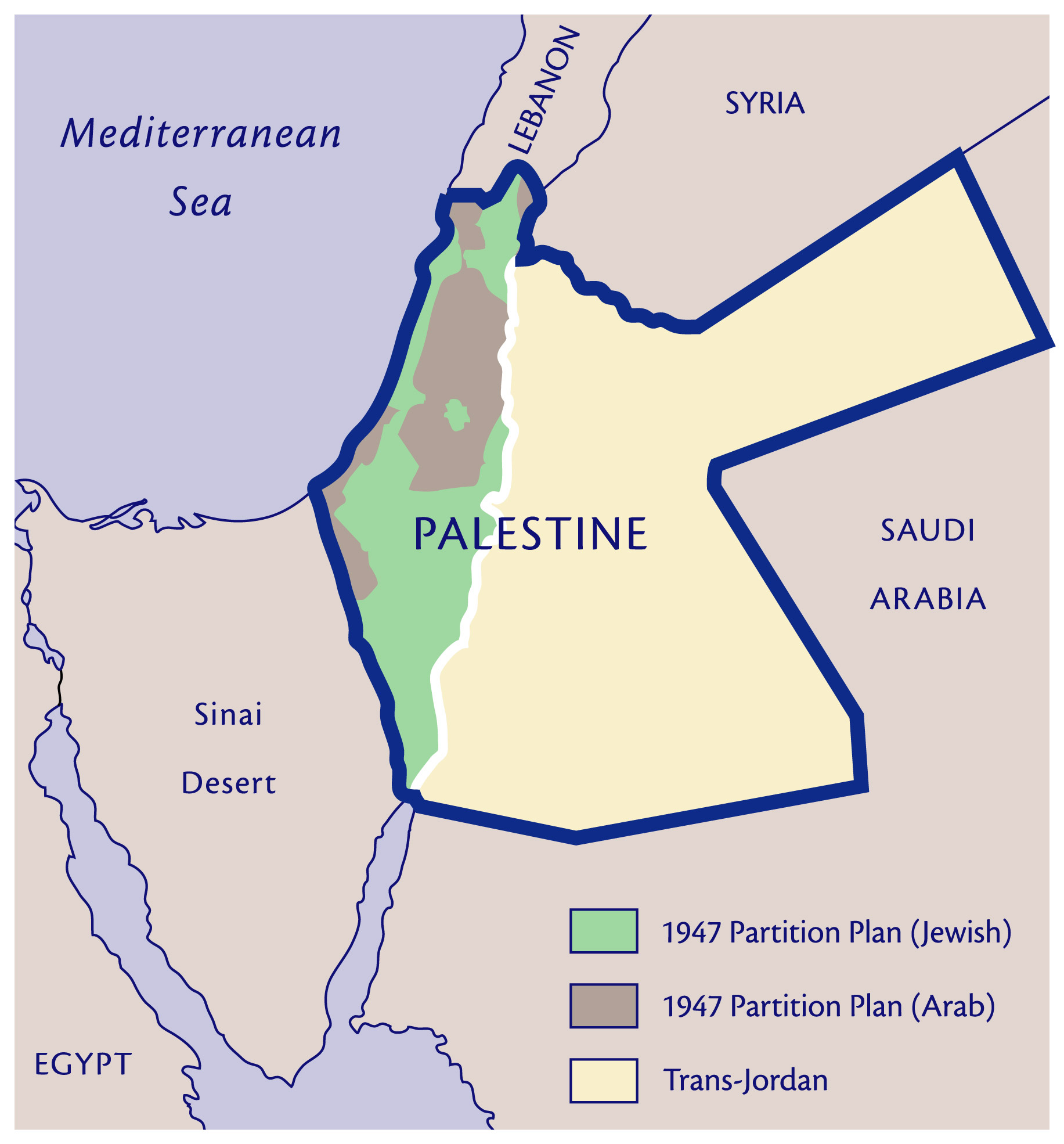 |
| Above is a map of Palestine before the partition by the United Nations in 1947. The outline in blue is what was formerly known as Palestine. During the aliyahs, Jews only settled in isolated locations west of the Jordan river (the faint white line running down the center of the outlined territory). After the Partition Plan was passed by the UN General Assembly, all area east of the Jordan river was declared to be the Kingdom of Transjordan (today known as Jordan, under the reign of the Abdullah family). The area west of the Jordan river was to be divided 55/45 between Israel and Palestine respectively. The green area represents Israel and the brown represents Palestine. |
The heart of the issue between Israelis and Palestinians is that they're both vying for the same piece of land. Israelis claim rights to the land based on their ancestral homeland. Palestinians lay claim to the land because they occupied it for roughly 2000 years after the Jews were exiled. This tension was only exacerbated by the newly formed United Nations' decision to create a new Jewish homeland called Israel in the land known as Palestine (this was done in part due to the guilt felt by the west for 1) knowing what was happening to the Jews in central and eastern Europe and 2) not having acted quickly enough to stop the atrocities).
Although this barely skims the surface of the incredibly complex issue that is the Israeli-Palestinian conflict, this does give an idea of the greatest portion of the dispute between both sides, and it's foundations.
Subscribe to:
Posts (Atom)